Anti-Carceral Mental Health Response Program
Building Mad Hubs
The goal of the Anti-Carceral Mental Health Response Program is to seed and develop a decentralized, well-resourced network of anti-carceral organizing and care hubs across the so-called “United States”.
By focusing on targeted geographic areas, we aim to unite isolated and un(der)-resourced Mad & disabled care workers and organizers to join forces in local communities. Through participation in our paid 6 month training program, fellows will receive guidance in abolitionist political education, practical skill-building, and will meet, collaborate, and organize with other fellows in their geographic hub.
After completion of the training program, organizing hubs will work together to create autonomous abolitionist alternatives like make-shift respite and crisis care collectives in their own communities. Hubs will have ongoing access to sustainable mutual aid support to enable their continued work - including stipends for caregivers, temporary housing support, legal advocacy, and emergency medication access.
Our Vision of Anti-Carceral Care
Often, the response to what is called a “mental health crisis” is to remove someone from the community and to push, prescribe, or even force people into narrow definitions of “care” and “healing”. Mad, disabled, and multiply-marginalized folks are pathologized, coerced, told what is “best for them”, and locked up in institutions against their will. We believe that “care” without consent is not care, and that self-determined healing can and should happen in community, beyond the carceral arms of the state.
When we dream of (and actively practice) anti-carceral care in our communities, we are describing:
Make-shift respites in our homes when community needs a supportive place to land for a few days
Mutual aid networks to meet basic and emotional needs
Rapid response, defense and advocacy when someone has been incarcerated (in a hospital or otherwise)
People that call on community, not cops and state agents
Skilled and resourced responders that center autonomy, self-determination, and politicized care
Access to healing practices outside of Western pathology-based frameworks
Emergency medicine and medication access
Geographic Hubs & Local Organizing
Responding to emergent mental health crises is often easier when diverse skillsets are combined, and labor is divided across individual capacities. Much of the current organizing within movements for psychiatric abolition exists in geographically isolated or socially siloed spaces, limiting our collective capacity and power to create and practice sustainable care. By focusing on seeding, training, and resourcing geographically local “hubs”, the Anti-Carceral Mental Health Response Program hopes to create sustainable collectives that can live on in communities.
In this first cohort, we’re seeding and supporting hubs in the following geographic areas:
Colorado
Rhode Island
Illinois
Remote/online (for house/bed-bound, distanced careworkers — by invitation only)
Uniting Isolated, Un(der)-Resourced Mad & Disabled Folks
There are so many people who already practice care in communities that go unrecognized, unsupported, and have little-to-no access to material, financial, or training resources. When we speak of care workers, we’re not necessarily talking about people who have a certification, work in a peer support job, or in a healthcare profession. We’re talking about people who show up within and for communities: barbers, educators, artists, and more. Care work doesn’t need to show up in your “profession”, and you don’t need to have a resume. Some of the best care workers are those that practice in their own homes, with their own families and friendships. These same care workers are often the ones that go without support or access to resources. The Abolitionist Mental Health Response Program aims to connect these isolated, unrecognized, under-resourced, highly skilled practitioners to (1) others in the local community for collaboration and (2) mutual aid infrastructure, material resources, and training support.
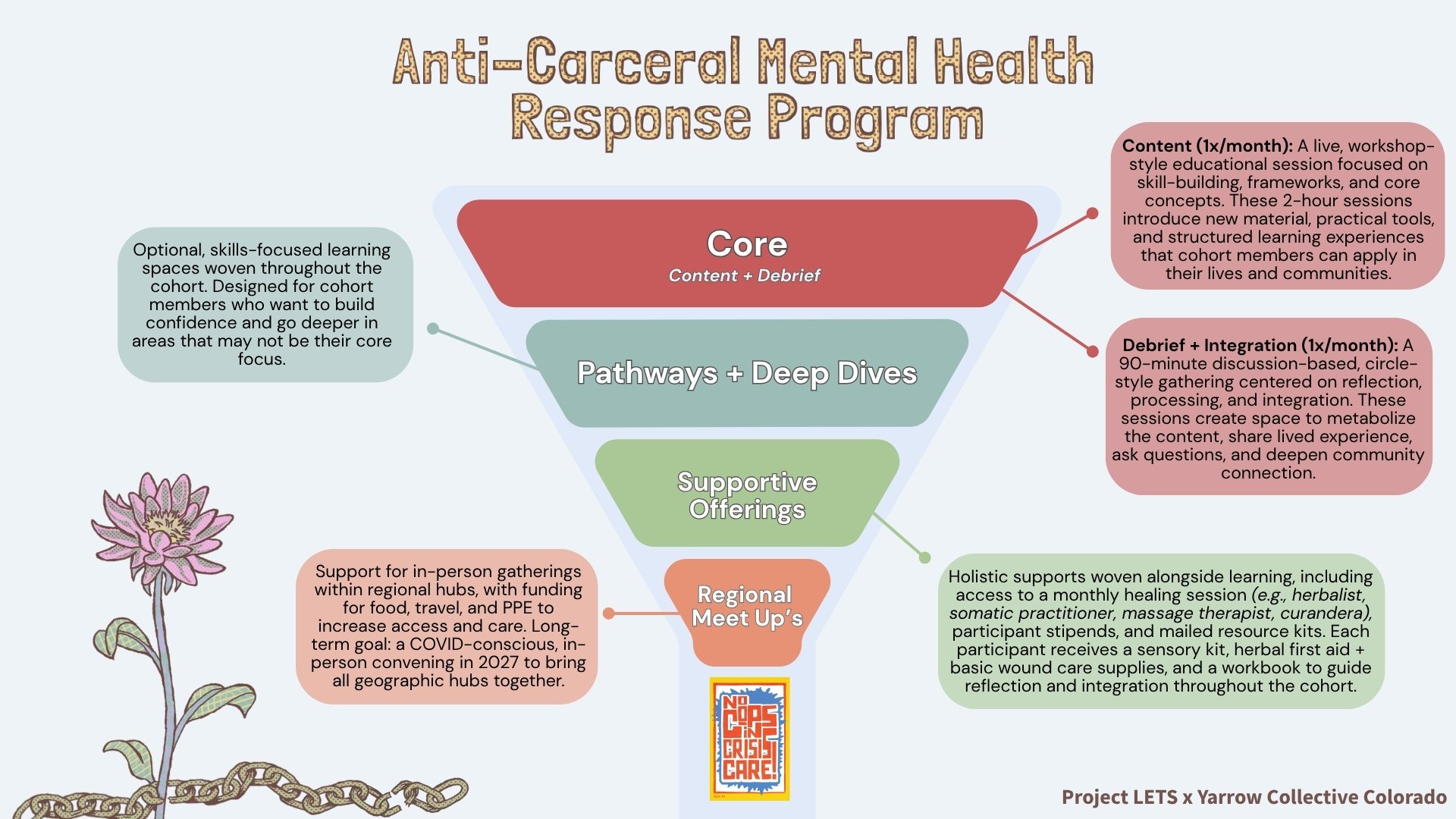
Program Participation, Timeline, & Access
-
All participants of the program will receive a $400 stipend in recognition of the skills, time, and intention that they bring to the space. 50% of the stipend will be disbursed upon the start of the program, and the remaining 50% will be disbursed upon completion of the training portion of the program. If there are any access barriers or alternative disbursement schedules pertaining to the stipend, we’re happy to discuss that 1:1 so that you can participate and be compensated.
-
We ask that program participants attend all scheduled sessions (barring extenuating circumstances). The training program is expected to take place largely on Zoom/virtual platforms (due to geographical spread), though local hubs are welcome to meet-up and organize in-person (not required).
The Anti-Carceral Mental Health Response Program will run for 6 months (September 2026 through February 2027). There will be three scheduled sessions each month:
Content Sessions: September 9, October 7, November 4, December 2, January 6, February 10 [6-8pm ET // 4-6pm MT]
Integration and Debrief: September 16, October 14, November 11, December 9, January 13, February 17 [6-7:30pm ET // 4-5:30pm MT]
Pathway Sessions: There will be three ‘tracks’ to choose from, and their schedules are TBD
Track 1: Incarceration Advocacy + Rapid Response
Track 2: Ancestral Healing + Plant Medicine
Track 3: Building Community-Based Alternatives
-
We are committed to ensuring that the program (and application) is accessible, as an organization run by and for Mad, Disabled folks. We invite you to share any access needs in your application if you would like to, and there will be additional opportunities to check in about access needs you may have before and during the program.
Application
At this time, we welcome applications from MMIND (Mad, “mentally ill”, neurodivergent, & Disabled) folks who…
Are living in any of the following states: Colorado, Illinois, Rhode Island
Are not currently licensed clinicians (or are in the process of pursuing licensure)
Can commit to attending scheduled program sessions
Want to build local organizing connections and collectives
Committed to enacting psychiatric abolition
If you fit these basic criteria and are still interested, we invite you to apply at the link below.
https://form.jotform.com/261425669906063
Applications are open from June 8th, 2026 to June 30th, 2026. Our team will then review applications and invite a small number of folks to check-in further either over the phone or on Zoom before being formally invited to join the cohort.